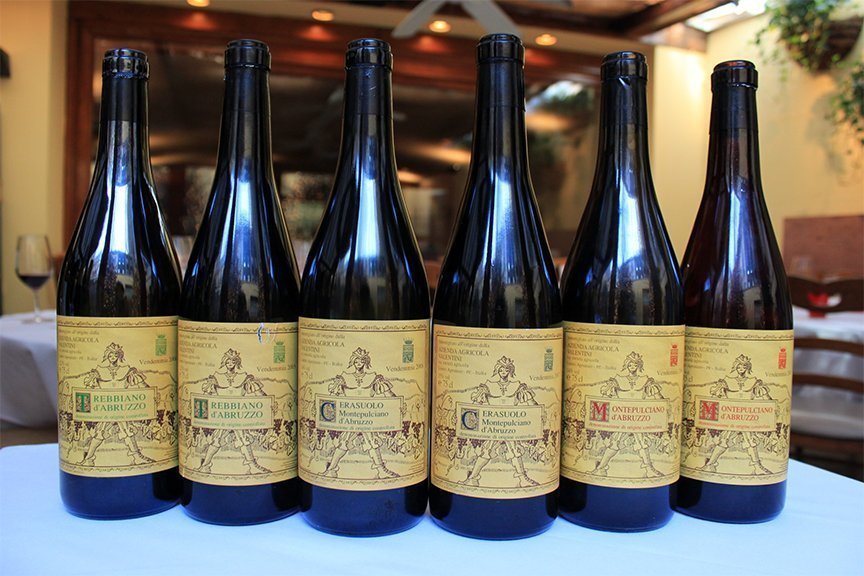
Above: Edoardo Valentini wines are regularly included in Italians’ lists of top wines each year. I can’t ever remember it appearing in a top 100 list by an America wine-focused publication.
In just a few weeks, the Slow Wine Guide 2017 Tour will come to the United States, including Texas, where I live. (The editors of the guide, Giancarlo Gariglio and Fabio Giavedoni, are both professors in the Master’s in Wine Culture program at UniSG.)
In just a few short years, the Slow Wine Guide has emerged as one of the most popular among Italian wine enthusiasts and winemakers. Where the Gambero Rosso shifted to a more commercial approach to its ratings and selections (and has been mired in conflict of interest and financial controversies), Slow Wine seems to have hit just the right balance between the commercial and the artisanal, the mainstream and the iconic, the crowd-pleasers and the classics.
Yet, if you collated a list of top wines from Slow Wine with a list from its editors’ American counterparts, you’d find gaping discrepancies.
I was reminded of this the other day when I was speaking with one of the top wine writers in the U.S. about Edoardo Valentini. To the Italians, it would be blasphemous to omit those wines from a “top” list. But those wines rarely appear — if ever — in American lists (honestly, I can’t ever remember them appearing in any list).
There are a number of factors that contribute to this. And the overarching element (in my view) is that the exchange of information between American and Italian wine writers is mono-directional.
Even though roughly 70 percent of Italian wine is sold in the U.S., American wine writers simply don’t read the Italian wine writers and wine bloggers. That’s due in part to the fact that few Americans speak Italian. But, sadly, it’s also due to a general apathy (and some might say arrogance) with regard to the Italian wine writing universe.
Another major factor is that many iconic wines from Italy are not widely available in the U.S. You’d be surprised by how many of Italy’s greatest producers have at best spotty representation in the U.S.
And perhaps the greatest factor is that U.S. wine writers tend to focus on “brands” that have been developed and built up by American importers and distributors.
Just look at this list of “essential” Pinot Grigio (not entirely Italian but mostly) by one of Italy’s leading wine blogs, Intravino. I don’t have any hard data on this but I can’t remember any of these wines appearing on a U.S. top list. Yet, I can say that, anecdotally, I know that all of the Italians listed here are considered to be icons by my Italian peers.
If I were to show this list to even some of the most informed English-language Italian wine writers today, I doubt they would recognize any of them (save for a handful of writers who follow Italian wine as closely as I do).
But ask nearly any American about Santa Margherita Pinot Grigio and it’s clear that the brand is one of the most iconic to come from Italy.
I’ve just offered a few broad examples here and there are many more. But there’s no doubt that this disconnect is something we need to consider as we reflect on how Italian wines are marketed and perceived in the U.S.
Image via Charles Scicolone’s blog.