
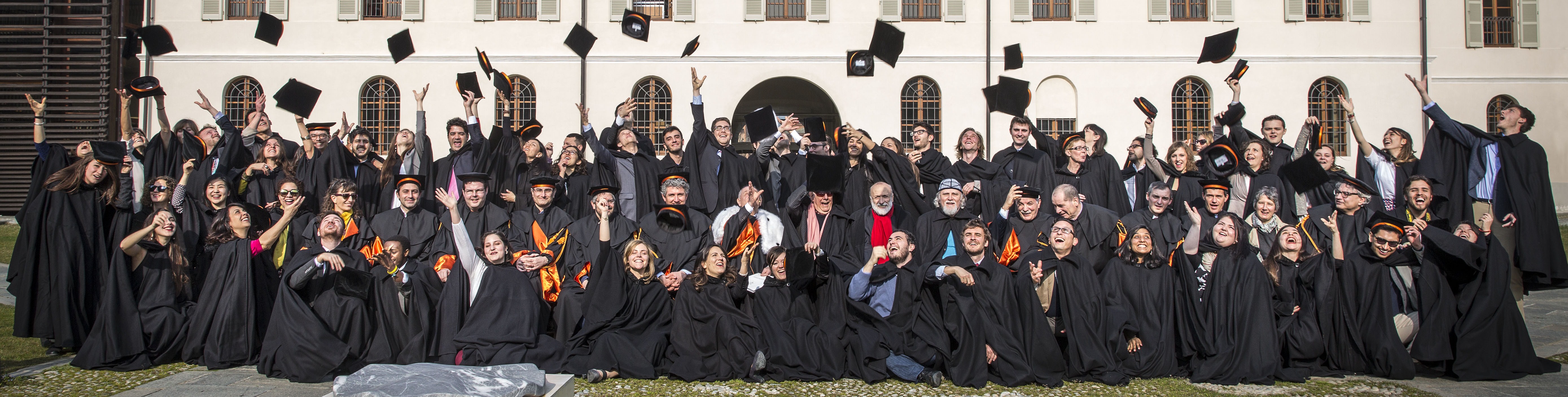
Pollenzo paid tribute to its new graduates today with the now traditional degree ceremony first staged in 2012: in a party atmosphere the students celebrated their much sought-after goal following a special ritual in which they don academic caps and tabarri, or tabards, the traditional black cloaks of the Langa district. They were met in the afternoon in the parish church of San Vittore by the university teaching staff, the dean Piercarlo Grimaldi, the president of the University Carlo Petrini, and special guests Carlo De Benedetti, Moni Ovadia and Dario Fo.
It was dean Grimaldi who welcomed the students’ procession into the church: “Today your adventure in the world of work begins but your training course here will be forever an important stage in your individual and collective growth. Go out now and be ambassadors of liberated good, clean and fair food.” He went on to recall that, “This year we are celebrating the tenth anniversary of the foundation of the University and you are hereby invited back to Pollenzo from June 14 to 19 to join in the celebrations.”
“The real challenge has only just begun,” said Carlo Petrini, “so never lose your humility and always be open to learning and understanding. You should never stop, either in happy times nor bad, and this is the beauty of life. Get ready now for our future get-togethers, from the tenth anniversary to Terra Madre. And wherever in the world you happen to be, remember that you are members of this community, keep in touch with the people you have met in Pollenzo and consolidate the network you are creating. You have given much more to me than I have given to you and now that you are leaving us, we wish to thank you for having been here. Be bold, be strong and may the name of Pollenzo stay in your hearts.”
Congratulating the new graduates, Carlo De Benedetti spoke about his own degree ceremony and how he presented his thesis while he was doing national service: “I turned up in my Alpino soldier’s uniform, which may have helped me earn an extra mark or two!” He added that, “You’ve chosen a profession that impresses me a lot because it will allow you to be leading players with all your creativity and imagination and the opportunities you create for yourselves without having to depend on outside support. You are venturing into the world of the immaterial and of excellence, a world of smell and scent and savor.”
The writer Moni Ovadia spoke to the students with customary irony: “If I hadn’t completed my studies, my mamma would have come back from the afterlife to make me get a degree! Actually I always enjoyed studying though I never figured out why I had to sit exams. Studying for me was the very meaning of life and that’s why I hope you’ll continue to study always, because people who study keep up a vital rapport with themselves and are always putting themselves to the test. Studying gives independence and a cultured person is and always will be a rich person. You study to nourish your bodies and your spirits because food has to be not just good, it’s fundamental that it should be studied too. Which is precisely why, you must realize, you will be precious for our future”.
Dario Fo entertained the audience with a sketch in “grammelot”, the theatrical language that combines gibberish with onomatopoeia to convey sense without meaning. He reminded the students that, “Culture needs imagination to exist and this is its strength.” He too added, “Never get fed up of studying and finding out more about things. After dramatic academy, I personally moved on to the Polytechnic to study math, the science of folly and of the impossible.” The Nobel Prize winner went on to dedicate his speech precisely to folly and antiquity: “It was studying the folly of theater that I discovered that commedia dell’arte actors were all professors and literati, had the vastest of cultures and were conversant with philosophy and geometry. I have always observed what’s happening around me very attentively, seeking to understand the truth behind the lies and to tell it in my stories. Be curious, always try to discover the origin of the tools you use and the ingredients of your food. Never stop at a single piece of knowledge and go after the things that bring you joy and pleasure.” Fo concluded his speech with a song in an unfamiliar language, while the audience clapped their hands to the rhythm.