
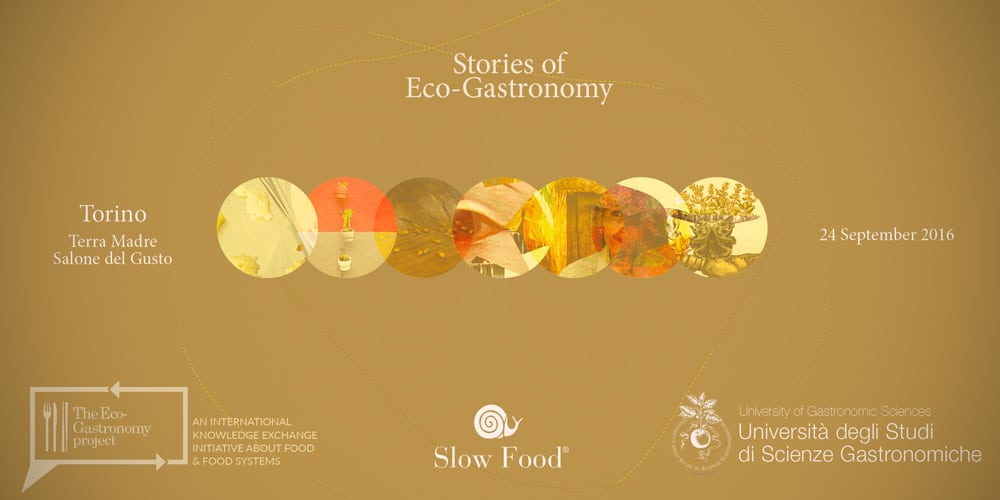
On Saturday, September 24 at 11:00 am at Parco del Valentino, the University of Gastronomic Science’s Eco-Gastronomy Project returns to Italy for the first time since EXPO Milano. The project’s director, Dr. David Szanto, will discuss the ethos and evolution of Eco-Gastronomy, and will recount stories from the last 10 months of his travels. To day, the Project has visited 12 countries and organized 20 events, each one aimed at building innovation, resilience, and justice into global food systems.
Modeled on the unique student experience at UNISG, the Eco-Gastronomy Project events merge “thinking, doing, and feeling” about food, while recognizing the systemic nature of food. At each stop, Dr. Szanto and local partners have collaborated to address locally relevant issues, while also building an ecological-philosophical vision of that region’s food system. The ultimate goal of the project is to share these stories worldwide while making them publically available through a living archive of online documents.
Dr. Szanto’s presentation will focus on stories gathered from Seoul to Oslo, Dili to Wrocław, Mexico City to Dublin, as well as the key themes that connect them. (See the following page for a complete list of events.) During this time, the Eco-Gastronomy Project has encountered some remarkable people, places, and food issues—from the socio-economics of biodiversity tourism in Timor-Leste, to the Scottish media politics of deep-frying Mars Bars, to the psychology of ‘happy’ cows in Norway. A key element of this event is to invite feedback from the public on how the Project can continue to evolve, including the themes and places to explore.
UNISG was founded in Italy in 2004 by Slow Food International. It offers undergraduate and graduate programs involving multi-experiential learning in classrooms, workshops, and in the field. The university’s aim is to build academic credibility for gastronomy while acknowledging that learning about food takes place through the mind and body, the heart and gut, as well as through all of our senses. To date, nearly 2000 students have attended from 75 countries.
Dr. David Szanto was one of the first English-language master students at UNISG in 2005, going on to work for the school in communications and outreach, as an instructor and program director, and now as UNISG’s professor-at-large. In 2015, he earned a PhD in gastronomy from Concordia University in Montreal (Canada), the first of its kind.
# # #
Event details: 11:00, Sept. 24, Viale Pier Andrea Mattioli 39 (Torino Polytechnic), Ganges Room
See old.unisg.oiss.io/ecogastronomy and the attached backgrounders for additional details.
For more information, contact a.gomez@unisg.it
Events, Dates & Locations
November 18–22, 2015: Seoul, Korea (Slow Food Asia Pacific Festival)
– public lecture: Eco-Gastronomy: Towards the Thinking-Doing-Feeling of Food
December 8, 2015: Mexico City, Mexico (Universidad Nacional Autónoma de México)
– University of Gastronomic Sciences information session
December 10, 2015: Mexico City, Mexico (Camelia Bistronomia)
– round-table: Mexican Gastronomic Culture: Ethics, Business and Food
February 12, 2016: Dili, Timor-Leste (Aru Café)
– storytelling workshop: Luhu Nights
Feb. 15–20: Singapore (National University of Singapore, B°NU Space, Lasalle College, HackerspaceSG)
– public lecture: Apparatuses of Eco-Gastronomy: Scale, Bodies, Performance
– University of Gastronomic Sciences information session
– performance workshop and showcase: Tactile Eating
– public lecture: I think my intestines like you: Art, Affect, and the Agencies of Food
April 25–27, 2016: Edinburgh, Scotland (Queen Margaret University, Summerhall)
– public gastronomy symposium: Scotland’s Foodscape
May 12/15, 2016: Wrocław, Poland: (Wrocław Food Think Tank, WRO Art Center)
– collaborative workshop: Feeding Art
– vernissage and artist talk: Orchestrer la perte/Perpetual Demotion
May 19, 2016: Oslo, Norway (Matlære: Food Talks, University of Oslo)
– lunchtime seminar: Performing with food: Interventions in gastronomic research
May 23, 2016: Ås, Norway (Vitenparken, Norwegian University of Life Sciences)
– public workshop: Constellations of Food Knowledge
May 25, 2016: Copenhagen (Kitchen Collective, Aalborg University)
– round-table discussion: Beyond Organic: Expanding the ‘Good’ in Danish Food
May 30, 2016: Dublin, Ireland (Wigwam Bar)
– storytelling evening: From Kimchi to Nýr, Passion Fruit to Beremeal
June 1, 2016: Dublin, Ireland (Dublin Gastronomy Symposium, Dublin Institute of Technology)
– conference presentation: Eater/Eaten: What Revolves Around Who?
June 20, 2016: Toronto (ON), Canada (OCAD University, George Brown College)
– design workshop: Interdisciplinary Sandwich
– public lecture: Stories of Eco-Gastronomy
September 15–16, 2016: Quito, Ecuador (Centro de arte contemporaneo)
– colloquium and tasting: A New Future for Traditional Ecuadorian Beverages?
– student workshop: Gastronomy in the World
September 24, 2016: Torino, Italy (Terra Madre/Salone del Gusto)
– public forum: Stories of Eco-Gastronomy
future events in Minneapolis, Portland, Melbourne, and Montreal to be announced
What is Eco-Gastronomy
Eco-gastronomy is a concept that views food systems through an ecological-philosophical perspective. It is an approach that merges the ‘thinking-doing’ of food (gastronomy) with an acknowledgement that when we think and do things with food, many different effects are produced. Sometimes these effects happen in real time, and sometimes later; sometimes they happen close to home, and sometimes further away.
Importantly, eco-gastronomy recognizes that food and food systems are made up of material elements, language and representation, and interactive processes. This means that any interaction with food can produce political transformations, environmental and social change, shifts in symbolic and conceptual meaning, as well combinations of all of these.
Eco-gastronomy is not limited to industry, or agriculture, or academia—it encompasses all food realms. It indelibly links food and humans, while bringing attention to the responsibility that all people have for the health and well-being of our food ways—producers, activists, cooks, academics, artists, politicians, and industrialists alike.
To date, the Eco-Gastronomy Project has visited Seoul, Mexico City, Singapore, Dili (Timor-Leste), Edinburgh, Wrocław (Poland), Oslo, Copenhagen, Dublin, and Toronto. The final destinations for 2016 are Quito, Torino, and Melbourne.
Unisg & David Szanto
The University of Gastronomic Sciences was founded in Italy in 2004 by Slow Food International. It offers undergraduate and graduate programs involving multi-experiential learning in classrooms, workshops, and in the field. The university’s aim is to build academic credibility for gastronomy while acknowledging that learning about food takes place through the mind and body, the heart and gut, as well as through all of our senses. To date, nearly 2000 students from 75 countries have attended.
Dr. David Szanto was one of the first English-language master students at UNISG in 2005, going on to work for the school in communications and outreach, as an instructor and program director, and now as UNISG’s professor-at-large. In 2015, he earned a PhD in gastronomy from Concordia University in Montreal (Canada), the first of its kind.