
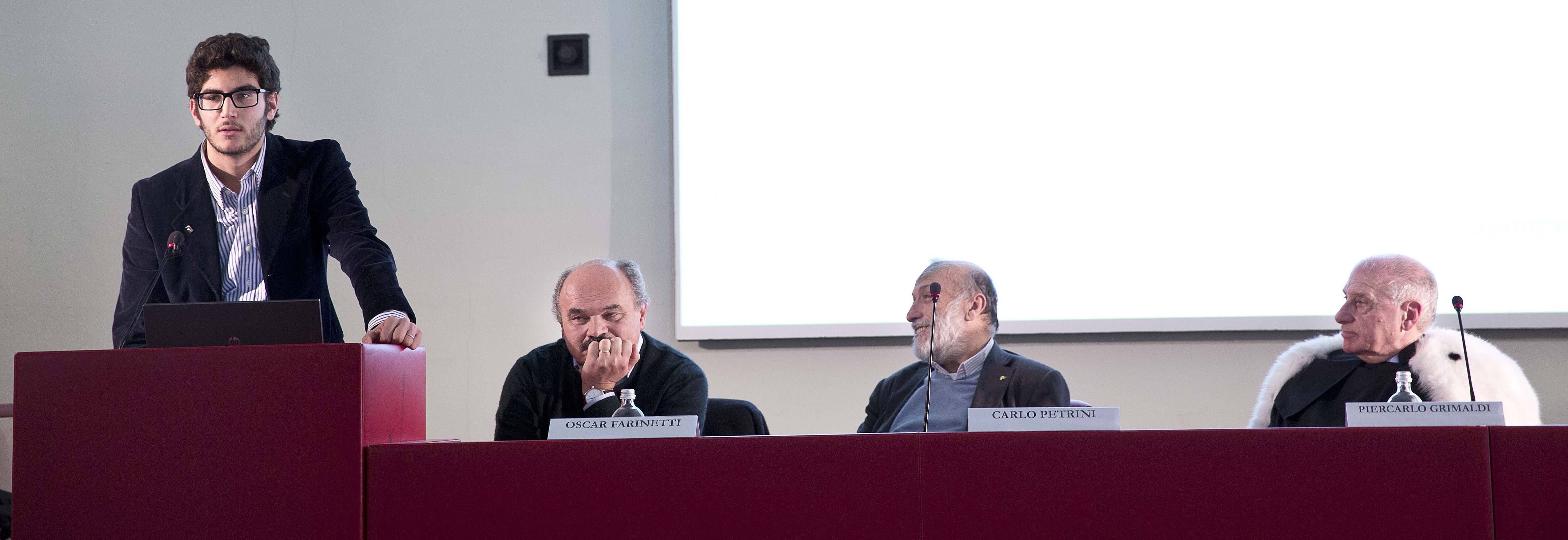
“The job the University of Gastronomic Sciences in the years to come will be to train people keen to make their dreams come true humbly and honestly. Interesting times are ahead and we have the chance to work to achieve great objectives. But we have to do this while keeping our feet on the ground.” This was the hope for the future of youngsters working for the cause of of good, clean and fair food expressed by president Carlo Petrini in his speech to inaugurate the 2012-2013 Academic Year in Pollenzo this morning.
“This is why one of this year’s new projects will be the Scuola di Alto Apprendistato, or School of High Apprenticeship,” he continued. “Even as the technological society destroys the value of human labor, so we are recovering old trades and professions to restore significance to craftsmanship, one of the pillars of our country. Bakers, master brewers, pork butchers and so on need to win back the space our society has always granted them, because they represent the fabric of Italian gastronomy. The new courses will enable participants to learn directly from master practitioners skills that could prove to be a source of gratification, defining the identity of their lives.”
Today also sees the launch of our Tavole Accademiche, or Academic Tables, project, an ambitious combination of education, top-rate cooking, fair prices and local food products. The first chef to appear in the new students’ cafeteria, housed in the kitchens named for Lidia and Guido Alciati in the Agenzia di Pollenzo complex, is Davide Scabin, patron of the multi-stellar Combal.Zero restaurant in Rivoli, near Turin. He will be followed by another 25 master chefs from nine different countries across the world who, over the next twelve months, will be the cafeteria’s guests for a whole week each. Together with four young UNISG cooks, the chefs will prepare complete menus reflecting the principles of good, clean and fair at a food cost of no more than five euros per meal. A tasty vegan option will also be available every day.
“I’d like this project to become a repeatable format, a milestone for all young people’s cafeterias,” said Scabin. “This is why I have respected the food cost guidelines to the letter, resisting the temptation to bring my whole crew to Pollenzo to stage an all-out gastronomic show. I’ve preferred instead to harness my technique to create original, imaginative dishes, using top quality local produce at a cost of less than five euros per meal.”
One of Scabin’s dishes during his week at Pollenzo will be Combal space lasagne, devised for the astronauts on NASA’s next international space station mission. You can discover his complete menu at http://goo.gl/V1Agx.
The inauguration ceremony also provided the Magnificent Dean Piercarlo Grimaldi with the opportunity to take stock of the situation at the University. “Over a thousand students from more than sixty countries have chosen to come to Pollenzo to study gastronomy at the highest scientific level,” he said. “Their families see our University as an educational project capable of giving them a concrete professional opportunity to overcome this moment of crisis. Over the last few years the University has created a new job description, that of the gastronome, a figure trained to recover food’s original function as a primary source of welfare that the Welfare State itself appears increasingly incapable of ensuring.”
Oscar Farinetti, owner di Eataly and president of the Association of Friends of the University of Gastronomic Sciences delivered the students of the UNISG a lectio magistralis on the words “future”, “courage”, “harmony” and “fortune”. “We have to regain the pleasure of the future and not be afraid of what may happen tomorrow,” he said. “We are living through the biggest crisis ever but we have the chance to ride the wave of this moment of momentous transition and chaos to build a new future”.
Two student representatives, Francesco Anastasi and Sebastian Sardo Melim, spoke about life at the University and encouraged freshers to exploit the huge educational and personal opportunities it offers. A survey carried out among the members of the Pollenzo community has, in fact, shown that the main motivations that lead youngsters to enrol are the outstanding experiences offered by study trips in Italy and abroad, the originality of the subjects on the syllabus, the chance to have new contacts with fellow students, lecturers and professionals in the sector and the opportunity to live in an international environment.
In the coming weeks another two big names on the international gastronomic scene will be taking part in the Academic Tables program: Giorgio Locatelli of the two-Michelin-starred Locanda Locatelli in London, from February 4 to 8, and Peppino Tinari of the Michelin-starred Villa Maiella in Guardiagrele, in Abruzzo, from February 11 to 15.
Click here for the full Academic Tables calendar: http://goo.gl/cP8Z1.
Besides the Academic Tables and the School of High Apprenticeship, another project that will be launched over the next few months is the Scuola di alta cucina domestica italiana, or School of Italian Domestic Haute Cuisine. Aimed at food enthusiasts, it will create a synthesis between high and humble cooking, between the cultivated and the popular, combining the two creatively to chart a new course of direct, practical learning and hence rehabilitate Italian domestic, daily, popular cuisine — the most authentic and highest culinary tradition the country has to offer.