
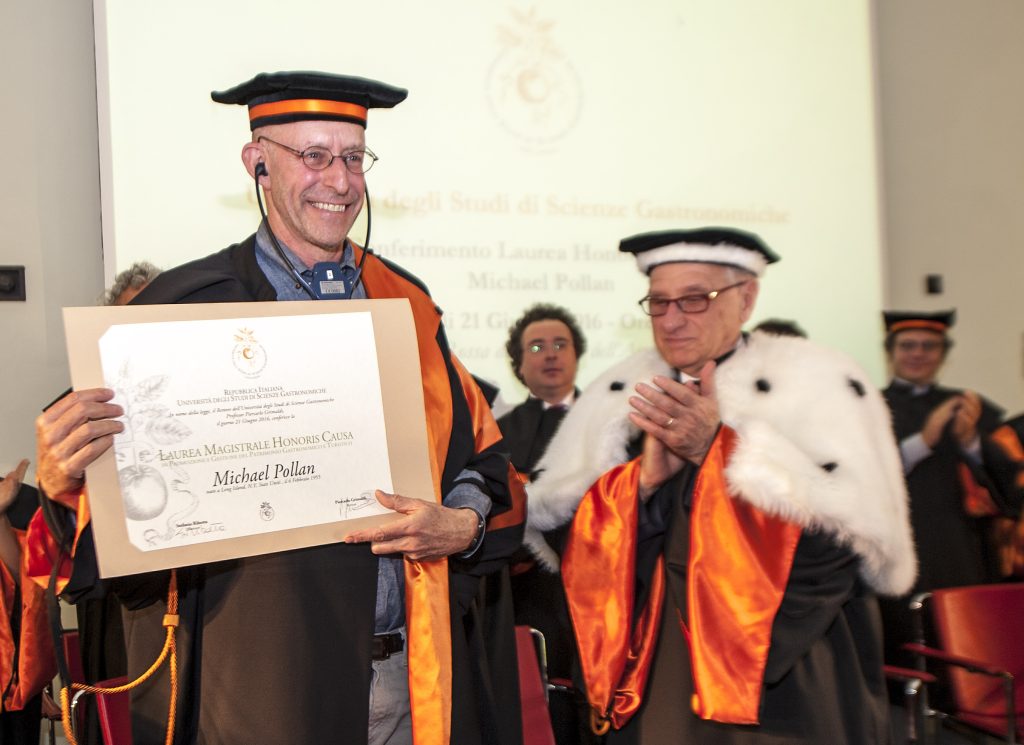
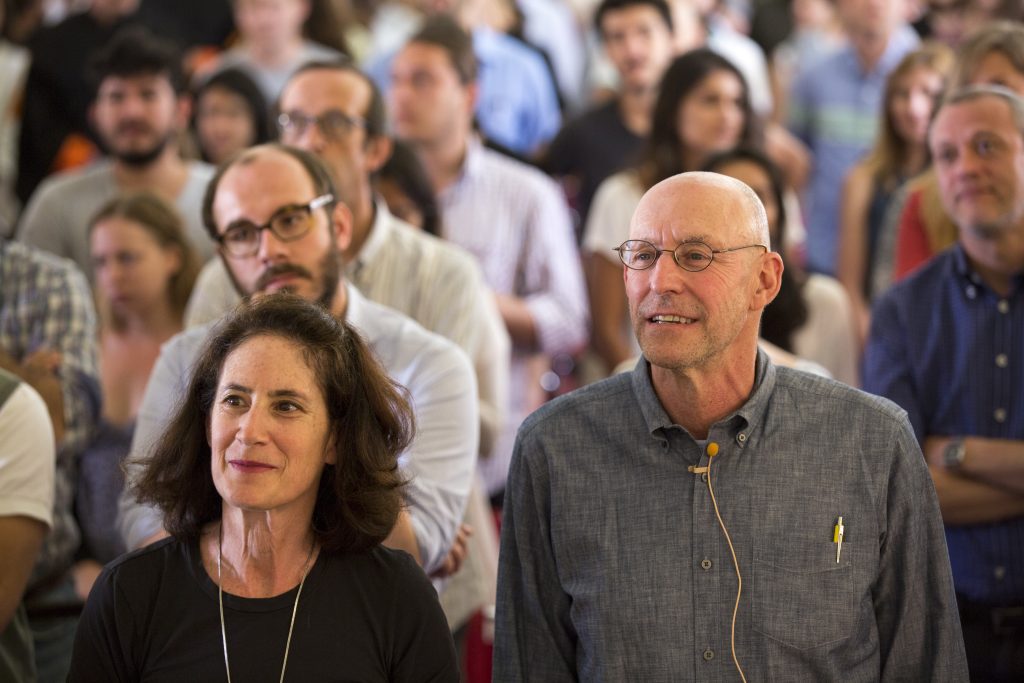
A crowded audience gathered in Pollenzo on Tuesday June 21 to watch Michael Pollan receive an honorary degree from the University of Gastronomic Sciences.
The American journalist, author of a series of key books on food—including The Botany of Desire: A Plant’s-Eye View of the World (Random House, 2001), The Omnivore’s Dilemma: A Natural History of Four Meals (Penguin, 2006), In Defense of Food: An Eater’s Manifesto (Penguin, 2008), Food Rules: An Eater’s Manual (Penguin, 2009) and Cooked: A Natural History of Transformation (Penguin, 2013)—received his graduate degree in Gastronomic and Tourism Heritage Promotion and Management from the hands of the university’s dean, Professor Piercarlo Grimaldi.
Dean Grimaldi opened the proceedings, explaining: “An honorary degree is not just a simple academic title, but a recognition of the value of a scholar and a model for future generations: Pollenzo considers Professor Pollan to be a full member of our university, a travel companion to whom we can turn when facing new and difficult bends in the road ahead.” He noted that the degree was being awarded for the contribution Pollan has made to increasing knowledge and communication in the field of sustainable gastronomy.
The laudatio was given by Andrea Pieroni, Professor of Food Biodiversity Sciences, Ethnobotany and Ethnobiology. He discussed Pollan’s major works, drawing connections between the essence of gastronomic sciences and Pollan’s holistic approach.
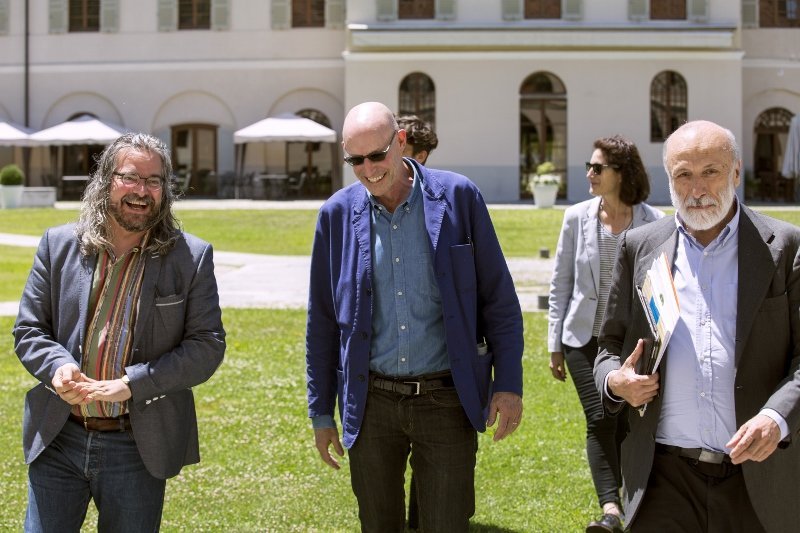
“Pollan was chosen because his published work is exemplary within the field of gastronomic sciences as it is understood holistically at the University of Gastronomic Sciences,” said Pieroni. “His professional biography is unique in the global media panorama. Pollan has followed original paths, particularly in the quest for a fertile interweaving between the analysis of food phenomena in an evolutionary key and a food activism imbued with fervent social tension and passion, redefining the very mission of food journalism. Starting from the two extremes of the observation of nature and the human body and their overall health/equilibrium, he questions the evolving nature of food, the contemporary mechanisms of food production, the relationship we have with food as individuals, community and society, the transformations of raw materials in the kitchen and their relationship with cultures and the role that a healthy relationship with food and the practice of domestic cookery has in food ecology and the creation of gastronomic sustainability. His work interweaves the themes of human-nature co-evolution and human ecology with those of nutrition and health, food sustainability and political ecology.”
In his conclusion, Pieroni summed up the distinctive style of Pollan’s writing: “This lies above all in the beauty of the narrative, in the ability to render the everyday gestures that connect us to food both noble and ironic at the same time, and in seeing them as part of the long co-evolutionary journey that humans have taken within food phenomena. He shows us food and the narration of food as a representation of ourselves and what and who surround us, of how we are and how we act, and of how we want to change the world.”
Demonstrating the gifts as a communicator that have brought him global fame, Pollan described to the students how and why he first began to be interested in food: “I began working seriously on food in around 2000, when I visited two big food companies to write an article on Monsanto and genetically modified potatoes. Monsanto invited me to come and see a very large farm on the East Coast. Here the farmer stayed in the control room, managing irrigation and the distribution of pesticides and fertilizers without ever going down into the potato fields. I started talking to him, and for me it opened up a window onto the agroindustrial world. I asked him why he used these pesticides. He explained to me that they were to prevent an esthetic problem, net necrosis, because McDonald’s would only buy potatoes with no defects. I asked him if there was a way to avoid this problem. He said yes, by cultivating other potato varieties. So I asked why McDonald’s would only buy this variety. He explained to me that it was because they had accustomed consumers to want all their French fries the same, identically regular and long. So you see, that’s the consumer’s desire.”
Later another episode also had a big impact on Pollan: “I was travelling from San Francisco to central California. All of a sudden I smelled a horrible smell. After a few miles, I saw the golden hills turn black, and I found myself in an area where cattle are farmed and fattened, with enormous pyramids of corn on one side and manure on the other. Here I saw the Happy Meal: first Monsanto’s potatoes and then the hamburger. I would never have imagined that we could have revolutionized agriculture to this extent. So then I asked myself where our food comes from: an urgent question, to which we need to find an answer.”
Pollan emphasized how we consumers are complicit in this aberrant system. We always want the same thing everywhere in the world, and this has led to significant changes in the food system.
The figures Pollan gave about food in the United States were particularly disturbing: “The standardization of agriculture and the lowering of costs is a system we have created: In the United States, one child in three eats at McDonald’s. We are fighting against an agroindustrial sector that wants to destroy food culture, that wants to make us eat alone or in our cars. That’s how 20% of the meals consumed in the USA are. The government calls this phenomenon secondary eating, a meal based on snack foods. The average American spends 78 minutes a day eating snacks, while only 68 minutes are dedicated to proper meals, what’s known as primary eating.”
Highlighting the importance of the work of movements like Slow Food, Pollan closed his speech with a message of hope for the students: “You need to understand how radical Slow Food’s ideas of change are at the moment. The first idea is that food is culture, not just fuel, money and science, and the second is that for us humans, eating is an act with different significance compared to other species. It’s a link with nature, because through cooking we transform nature into culture. It’s the prototype of a cultural process.”
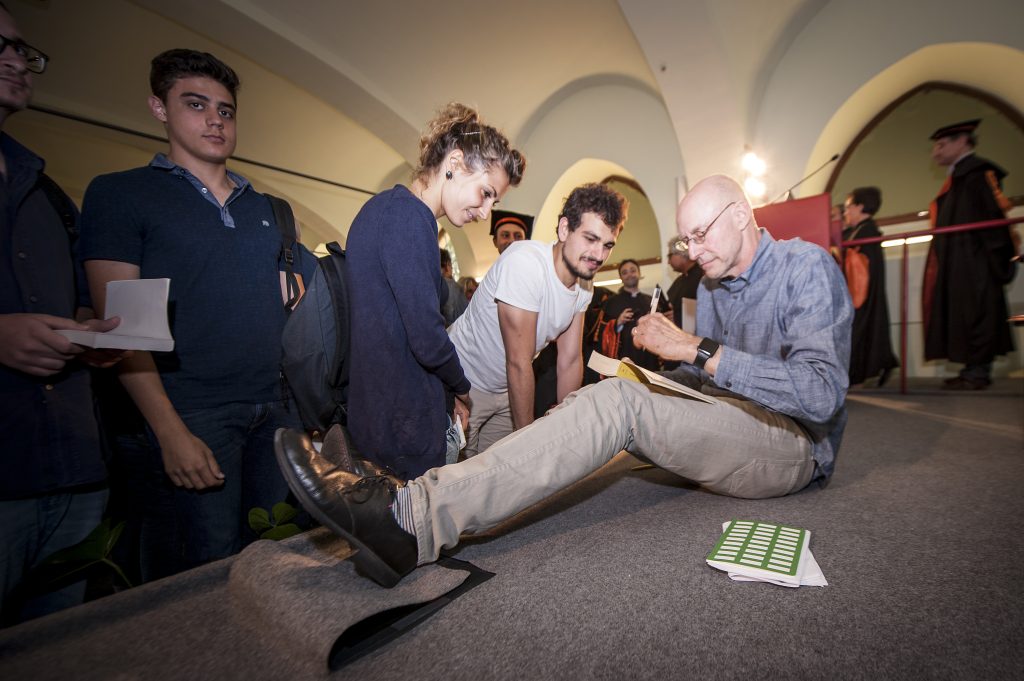
The writer then asked for questions from the audience, leading to a lively discussion with the university’s international student body.
Closing the ceremony was UNISG’s president, Carlo Petrini, who noted that the awarding of the degree to Pollan came at the end of five intense days, with professors and students holed up to work on reformulating the foundations of the new gastronomic sciences degree class. “I met Pollan in California in 2003 when he was a young journalist, before this university was founded. Now Michael Pollan is here with us and he has become one of the most authoritative personalities in food studies at a global level. Michael, we want you to feel that this small but increasingly international university is your home.”