
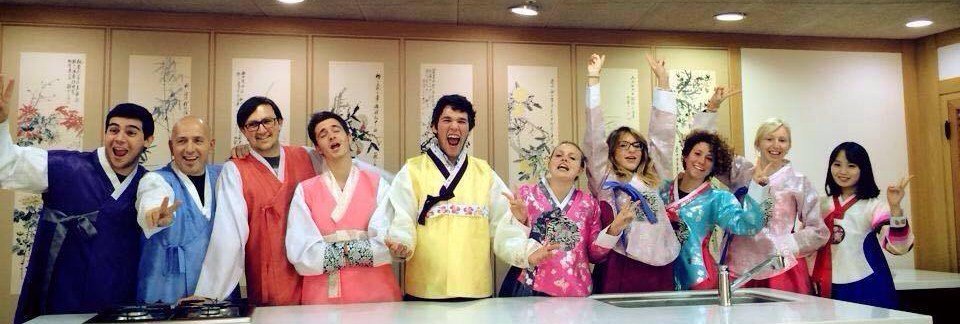
On November 10, 2014, eight UNISG students and a tutor started their journey in Korea. From Jeju Island to Jeolla province and to Seoul, this study trip was not simply to discover Korean cuisine, but to find out the links between people, local traditions and food.
The students began the trip visiting the blue Kongjang producers from the Ark of Taste and experiencing traditional street food from the island and ocean resources.
On November 14 in Wando, they visited the young abalone farms, the mature abalone farms, and the anchovy fishery.
Then they had lunch with Jang-heung Sam Hap, Jang-heung beef, pen shell scallops, and shiitake mushrooms. In Nampo the group visited an oyster harvesting site, wearing orange long boots and spending half a day in the mud. They also ate oyster soup made from oysters they had caught and cleaned themselves.
One of the students, Giorgia, 21, said about this experience: “The oyster experience in Jang-heung was a great opportunity to compare the oyster system of Korea with the Italian one.”
The students also experienced the taste of Hobakjuk (pumpkin rice soup) preparing it together with people of Wu-bung village Hwasoon. The village people performed the traditional local show of Woo-bung, Wu-bung Deulsori, demonstrating ancestral rites, Dangsanje, in front of the tree Dangsan: this is referred to the 15th day of the new year according to the lunar calendar.
UNISG students enjoyed this ritual and Eleonora, 21, explained: “In our university we learn about the variety of traditions and cultures. I had the impression here in Korea that such things are still alive. The relationship of the villagers was very surprising and new.”
The leader of Slow Food Naju, Hongyanghyeon, said: “I brought two students fishing in the early morning to the Jindong reservoir, where I used to go swimming during my childhood. One of them, Adriano from Sicily, told me he felt amazed and thankful to have this experience in Korea. He was very happy to get to know traditional culture. He told me that the tea ceremony in the temple impressed him a lot, and that he loved the deep culture of food. He also thinks that the Korean Slow Food network is like a family. It was a big humane experience, for him, to have the chance to go fishing at 5 am in Naju.”
Students also had the chance to taste skate fish in Youngsanpo of Naju. Clara, 21, said: “The skate is a very impressive food. I could see a new fermentation process. Compared to Italy, South Korea has very different food cultures, but here I feel comfortable as if I’m at home”. Another student, Kim from Germany, 21, said: “Skate is really a shocking food. The smell was too difficult for me.”
The Korean study trip took place thanks to Slow Food Korea, Korean Food Foundation and the Korea Buddhist Culture Consortium.