
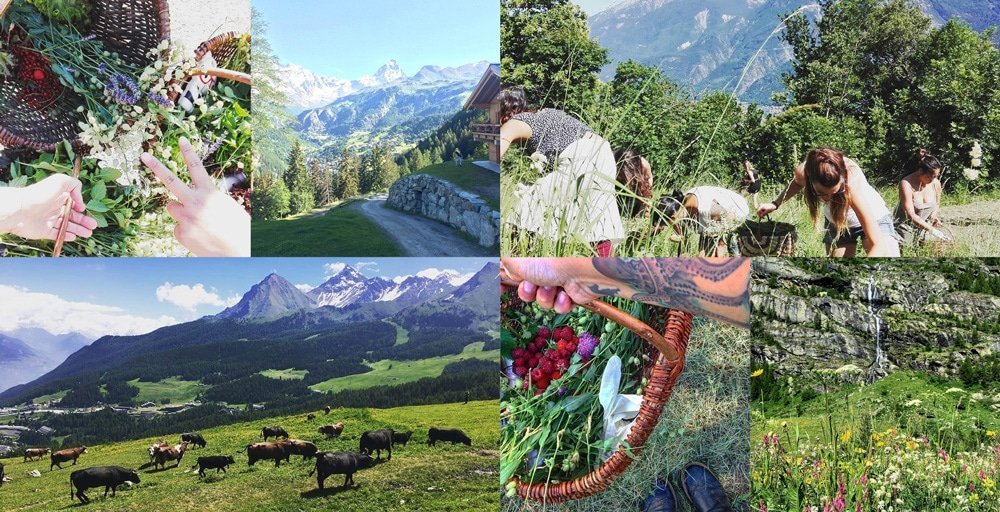
Alpine Gastronomy: UNISG Study Trips Return to the Valle d’Aosta for Mountain Wines, Cheeses and Produce with a Focus on Sustainability.
The study trips organized by the University of Gastronomic Sciences continue: From August 29 to September 3, 2016, 12 students—from Italy, Rwanda, Croatia and South Africa—in the first year of the three-year undergraduate degree will be travelling to the northern Italian region of Valle d’Aosta.
Thanks to the collaboration of the Agriculture and Natural Resources Department of the Autonomous Region of Valle d’Aosta, and the support of a number of businesses that have entered into agreements with the university in order to promote the region’s local foods, the students from Pollenzo will have a chance to discover an Alpine region of great beauty which offers a wealth of outstanding gastronomic heritage with ancient roots.
The program of visits, meetings, lessons and tastings, designed in collaboration with the regional agriculture department, will start on Monday August 29 with a visit to the Montfleury farm in Aosta, run by the Institut Agricole Régional (www.iaraosta.it), a school and research and experimentation center. Here, a number of experts will explain dairy, cheese, fruit and vegetable production techniques and the institute’s activities while also discussing the strengths and weaknesses of Valle d’Aosta’s agriculture. The UNISG group will visit the institute and participate in a lesson on research into mountain agriculture techniques with director of experimentation Andrea Barmaz.
Next they will move on to the Cofruits agricultural cooperative (www.cofruits.it), a modern, well-equipped center for apple harvesting and storage. Here local growers bring their fruits and receive assistance with cultivation techniques and improving different apple varieties. The students will be welcomed and led on their tour by Attilio Fassin, the cooperative’s president.
Following this, they will continue on to the Maison Bruil (www.tascapan.com/maison-bruil-valle-aosta) in Introd, an old country house built so that all the people and animals could be housed together under one roof. Here they will learn more about Valle d’Aostan architecture and visit the Food Museum, which has a focus on local products and small-scale producers.
At the Maison Bruil, the Councilor for Agriculture and Natural Resources, Renzo Testolin, and the chairman of the Chambre Valdôtaine, Valle d’Aosta’s Chamber of Commerce, Nicola Rosset, will greet the students. The day will end with a dinner and tasting focusing on Valle d’Aosta’s food and wine, with a particular look at the region’s meat industry in collaboration with AREV, the regional association for livestock farmers, which aims to improve native breeds and farm competitivity. Stefano Celi, president of the association of Valle d’Aostan viticulturalists (www.vivalvda.it), will also be providing an overview of wine production in the region.
On Tuesday August 30 the day will start in Châtillon, at Paolo Vittaz’s Douce Vallée (www.doucevallee.com), a farm specializing in the production of fruit vinegars, from apple and pear to berry. The berries are harvested from the mountain slopes in July and August, when perfectly ripe, then immediately subjected to a delicate natural fermentation. The final result is a highly fragrant vinegar with an intense red color, unpasteurized and made without any added colorings, preservatives or other additives.
The students will then move on to Nus to visit the Maison Rosset (www.maisonrosset.it), a holiday and teaching farm specializing in livestock. As well as cheese and other dairy products, meat, cured meats and eggs, it also produces fruit, vegetables and other crops. Most of the farm’s output is used to prepare the typical recipes that are served in the Ristoro della Maison. Maison Rosset works actively with schools to promote projects aimed at increasing awareness of the agricultural environment among younger generations, particularly thanks to its teaching farm area, used by schoolchildren of all ages.
The afternoon will be dedicated to another valley farm, Elisa Dorrier’s Genuinus (www.genuinus.it), and the subject of cooking with herbs and flowers. The farm covers three hectares, planted mostly with berries (raspberries, blackberries, currants and gooseberries) for the production of jams, juices, sauces for meat and cheese, dessert sauces, vinegars and syrups.
The program for Wednesday August 31 includes a visit to the PDO Vallée d’Aoste Jambon de Bosses (www.jambondebosses.it) production facility in Saint-Rhémy-en-Bosses. At the foot of the Colle del Gran San Bernardo, the Great St Bernard Pass, at 1,600 meters above sea level, the small, tourism-oriented village has a rich cultural, environmental and gastronomic heritage, including the production of a PDO ham. Since the Middle Ages, the Valle del Gran San Bernardo has been one of Western Europe’s busiest transit routes, and a hub for important commercial traffic. A community of Augustinian monks decided to build a church and a hostel here, to provide food and lodging for passers-by. Documentation about the production of the jambon dates from that period, when the ham was used by the local people to compensate the monks for their work. But even earlier, the “Tybias Porci” inventory registers of sale or exchange show evidence of cured pork legs being used as a high-value medium of exchange. These days, PDO Vallée d’Aoste Jambon de Bosses production takes advantage of modern technology but has remained more or less unchanged through the centuries, thanks to the passion of the small Saint-Rhémy-en-Bosses community.
In nearby Valpelline the UNISG group will be hosted by the Chambre Valdôtaine, before moving on to the visitors’ center and aging warehouse for PDO Fontina (www.fontina-dop.it – www.fontina-valledaosta.it ), where they will be welcomed by the director of the Cooperativa Produttori Latte e Fontina, Ezio Toscoz, and the president of the Consorzio Produttori e Tutela della DOP Fontina, Livio Vagneur, to learn about the production of the world-famous “queen of cheeses” and watch the forms being branded. PDO Fontina is soft and melting in the mouth, with a sweet, mild flavor. Its production is regulated by a strict set of specifications, which define it as “a full-fat cheese with a semi-cooked paste, made from whole cow’s milk from Valdostana breed cows (Pezzata Rossa, Pezzata Nera, Castana), from a single milking.” In 1996, Fontina obtained a Protected Denomination of Origin from the European Union, confirming unequivocably that it must be produced in the Valle d’Aosta, an area with specific geographical, soil, climate, agricultural and cultural conditions, and protecting it from attempts at imitation. Once the cheese has finished aging, after a series of strict controls the Consorzio Produttori e Tutela della DOP Fontina brands the cheese, guaranteeing its authenticity and quality.
On Thursday September 1 the students will set out for Valtournenche, at the foot of the Matterhorn, where they will visit the La Péra Doussa (www.laperadoussa.it) agriturismo (holiday farm), which thanks to new technology and innovations has become a small eco-sustainable oasis. Since 2007, the agriturismo has been completely self-sufficient, producing its own hydro-electric energy and heating its buildings using a woodchip boiler, fuelled by small pieces of wood cut in a special machine.
Still in Valtournenche, the afternoon will be dedicated to the Cooperativa Valle del Cervino, which twice a day collects milk from the cows of farmers living in Valtournenche, Chamois, Antey-Saint-André, La Magdeleine and Torgnon for the production of PDO Fontina. The daily production of 80 to 90 forms in the summer and 50 to 60 in the winter means that around 25,000 cheeses are produced every year. Each weighs between 8 and 10 kilos and is alternately salted and cleaned while aging. The aging takes four months, and after a strict selection, the best cheeses are branded at the Valtournenche, Antey-Saint-André and Châtillon sales points.
The students will then visit the permanent exhibition at the Maison de l’Alpage (www.alpages.eu), which offers an overview of mountain pasturing from various perspectives: entrepreneurship, modernity, multi-functionality, knowledge, skills, the rural culture created over time and the ecological sustainability of the Valle d’Aostan system. Through interviews and videos, in-depth sections, photographs and panels, the students will be able to learn all about the concept of bringing livestock up to mountain pastures in the summer: the related architecture, etymology and business; the geography, including the steep slopes and the ecosystem; the flora of the valleys, including pasture management and the characteristics at different altitudes; Valdostana cattle, including the history, evolution, types and characteristics of the typical local breeds; and industrial production, with the modern transformation “from grass to cheese” and its eco-sustainability thanks to the use of cutting-edge equipment (www.arev.it).
The focus will switch to wine on Friday September 2, with a visit to the Cave Mont Blanc de Morgex et La Salle (cavemontblanc.com) in Morgex, Europe’s highest winery and vineyard. Founded in 1983, during its first ten years the Cave doubled its number of members (currently around 80) and increased production, which is now around 140,000 bottles a year. This output might seem small compared to other wineries, but reflects the limited area under vine and the geomorphological characteristics of the land. For the last decade, the Cave Mont Blanc has been experimenting with the production of sparkling wines at high altitude, thanks to the collaboration of the Courmayeur society of Alpine guides, leading to the development of Blanc de Morgex et de La Salle Metodo Classico Extrabrut “Cuvée des Guides.” Originally entirely produced at the Rifugio Monzino, the wine is now continuing its journey with the Mont Blanc cable cars up to Pavillon at 2,173 meters above sea level. The tirage is carried out in the new high-altitude winery, followed 24 months later by dégorgement. The altitude, the atmospheric pressure and the temperature, as well as the particular care required during production, give the wine unique characteristics.
The day will continue in Courmayeur with a visit to Alessio Zerga’s Le Rêve agriturismo (www.agriturismolereve.com), a farm that rears cattle, sheep and goats and cultivates berries and vegetables. Afterwards, in Morgex, the students will meet Diego Bovard from Lo Gran, an association that unites around 20 small-scale growers of wheat and rye and one mountain saffron producer.
The last section of the study trip involves a visit to the Distillerie Saint-Roch (www.saintroch.it) in Quart, where high-quality liqueurs are produced, and to Arnad, to the Salumificio Maison Bertolin (www.bertolin.com), to learn about one of Valle d’Aosta’s emblematic products, PDO Vallée d’Aoste Lard d’Arnad. This unusual lard is aged inside doils, ancient chestnut or oak wood tubs, in which the lard is alternated with layers of salt, water, spices and aromatic mountain herbs. This traditional method of curing is so old that Arnad Castle’s first inventory, from 1763, mentions the presence of four doils in the kitchens. The wonderful flavor of the cured lard recalls the herbs used in the curing, and each slice is pure white, sometimes with a subtle vein of meat, shading to a pale rose in the center. The main promotional event for the delicacy is the Féhta dou lar, the lard festival (www.festalardo.it), held for almost 30 years in the last weekend of August, which attracts growing numbers of enthusiastic lard connoisseurs.
© UNISG Instagrammers’ photo credits: @ebavere @wendmah @johanhkf @diego_bovo @andrea.bianchi